The cases of Rosa Alfano and Gerarda di Cunzolo have already been mentioned in relation to the foreign occupation.
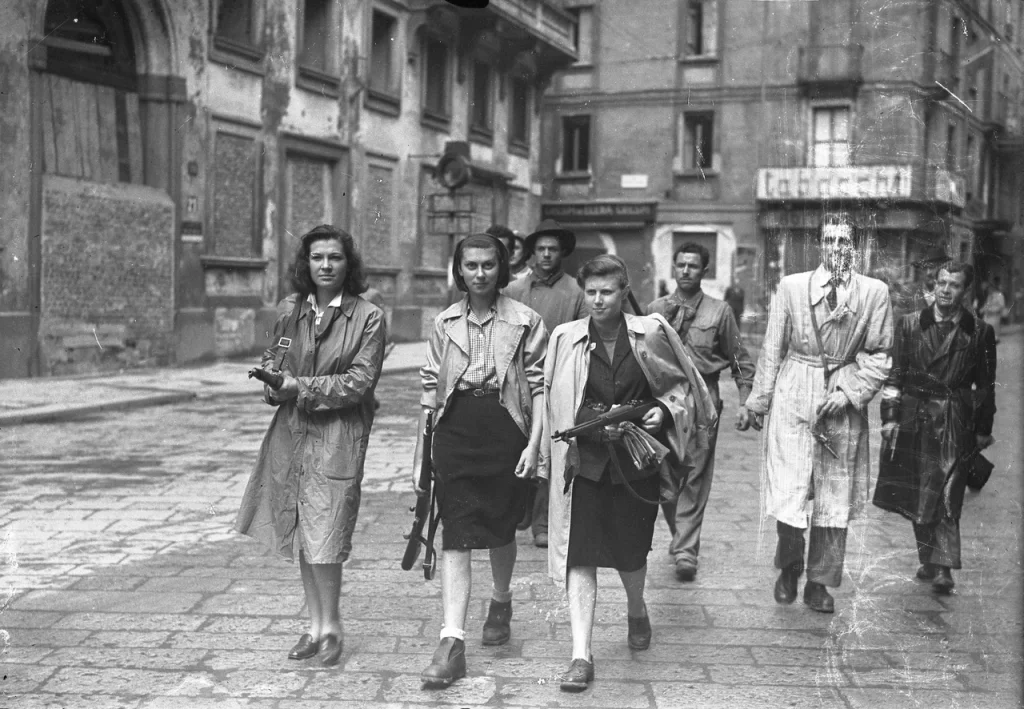
Women played a fundamental role in the Resistance. They served as staffette, taking advantage of the widespread tendency not to perceive women as combatants, but they also took up arms and went into the mountains. The following photograph, taken in Milan, is one of the most iconic images of the Resistance and of women’s contribution to it.
A constant throughout the period between the two World Wars was the struggle against Fascism; there were conspiracies. Carmela Crovetti recounts the abuses suffered by people in her home town, Belvì, at the hands of the Fascists; the village was frequently visited by Emilio Lussu, the founder of the Partito Sardo d’Azione (Sardinian Action Party).
Some women were arrested; for some of them, liberation came with the fall of Mussolini on 25 July 1943 (as was the case for Maria Lisa Cinciari Rodano). Fascism imposed its rule: some fathers, by claiming certain forms of disability, managed to obtain exemption from military service. They therefore did not expect to be called up; they did not hold a Fascist membership card. To avoid Fascist parades, they would sometimes leave the village with their families. In this way, they became acquainted with different festivals and rituals (for example, the Frascati Carnival and the Feast of St Rosa in Viterbo). This account comes from the testimony of Iole Mancini.
It is an interesting phenomenon: escaping from a historical event that does not correspond to one’s own role in history —and is therefore not part of one’s personal life— and to find oneself discovering other fragments of history. There is a relationship with anthropology embedded in every historical detail: during wartime, rituals and defence mechanisms against reality are adopted. One may think of the women in Primo Levi’s If This Is a Man, who prepare everything their children will need before they are deported: they wash the children and their clothes, feed them, and prepare their toys. These women carry out ordinary tasks, despite being fully aware of the future awaiting them the following day.
Tina Costa experiences a troubled childhood; her family is anti-Fascist. She is a strong and determined child. At school, she is marginalised and not treated on an equal footing with the other pupils. Her teacher is very harsh towards her and a staunch supporter of Fascism; she is the sole teacher in a class of thirty children. Tina’s parents are mistreated because of their political views. Her father is frequently detained and tortured, while her mother tries to make reality seem less obvious and harsh. She constantly asks Tina about the treatment she endures every day at school. Tina lives under these conditions of social oppression and decides to react: she refuses to be intimidated. As the years go by, her political commitment become increasingly intense. She joins the Resistance and become a member of the Communist Party. This is her account of her childhood experience under Fascism:
Video: Tina Costa (segment 1, “Presentazione”; full video).
Ermenegilda Berardelli recalls having cried because of the Fascist regime and the customs imposed by the dictatorship, such as the Piccola Italiana and Giovane Italiana uniforms; her mother’s brother was arrested and sent into political confinement.
Testimony of: Ermenegilda Berardelli (segment 2, “Fascismo”; full video).
Among the women interviewed, some speak positively about Fascism; among them is Severina Lubrani, who explains:
Video: Severina Lubrani (segment 3, “Fascismo”; from minute 00:00 to minute 1:06).
As regards relations with the Germans and the Allies, the accounts vary and differ on certain points. Maria Teresa Persico describes the Americans, who had requisitioned many flats in Naples, as very intrusive. She describes the Germans’ attitude, by contrast, as stern and aloof. She also speaks of the terror caused by German bombings.
Then Naples was liberated, and we —my grandmother, as always —heard the news that the Americans were requisitioning all the flats in the building, so we went back to Naples. I think that in the whole building only two or three flats were spared, because we had a tenant who pretended to be living there; anyway, it was quite a story. It was unpleasant because the entire communal corridor had been requisitioned by the Americans, who’d turned it into a club. Every time I walked through it to get to my flat—because I live at the end of this long corridor—we had to show a pass, because they did it out of spite. I was a seventeen-year-old girl and, as they say in Naples, it was just to ‘sfruculiare’ me, you know, to wind me up. That wasn’t a pleasant time because these Americans, unlike the Germans who kept their distance with great strictness, with a lot of… well, they were very jovial, but very intrusive indeed, very, very, very intrusive.
Together with her mother, Elena Bernardinelli hosts German soldiers in their home in Castel Venzago, where they spend the night while looking for accommodation before leaving again the following morning. Because of this, the partisans from her village mistreat them; they are taken to prison, only be released the following day, probably by the mayor, who recognises that the two women have nothing to do with it.
Video: Elena Bernardinelli (segment 4, “I tedeschi in casa”, in full).
Among the women, however, there are also those who experienced an act of kindness from German soldiers during a particularly tense moment, namely the period immediately following the Armistice. This is the case of Fausta Monelli who, together with a friend, attempted to return from Milan (where she had taken a university exam) to Fermo. They managed to get home just in time thanks to the assistance of these soldiers, who were then invited by Fausta’s family to stay for lunch. One of the soldiers, deeply moved, explained that it was the first hot meal he’d had in two years.
Video: Fausta Monelli (segment 4, “L’orrore della guerra”, from 5:06 to 7:04).
Those who had no choice but to flee, whenever it became possible, were Jewish women, whether Italian or foreign nationals living in Italy. The latter were interned in Italian concentration camps immediately upon the outbreak of the war; the former, already discriminated against by the racial laws of 1938, often faced the tragedy of deportation after September 1943, when the Salerno landings split Italy in two. Those who managed to escape the raids by the Nazi occupiers either fled or, like Sylvia Elfner, joined the partisan brigades.
This courageous choice did not spare Sylvia from the worst fate, whilst she was accompanying Major Leslie Young —who had escaped from the prisoner-of-war camp at Fontanellato, near Parma— towards Anzio, where the Allies had landed. The group was intercepted, and German machine-gun fire killed Sylvia, her brother, and another partisan. Major Leslie Young’s son, who survived that episode, later recalled this act of courage and solidarity, which came at a very high price.
Testimony of Nicolas Young
‘[My father] was travelling with a lively New Zealander called Charlie Gatenby, and together they crossed the snowy Apennines in January 1944 on their way towards the Allied front at Anzio. After spending Christmas in a village called Corvaro, they were eager to complete the final stage of the journey, but were understandably uncertain which route to take and how to avoid the German patrols and minefields. My father’s diary merely states that they met two Italians, a brother and sister, and together they decided to try to get through. I later discovered, through Charlie’s daughter, that the sister’s name was Silvia Elfer, and that there was a third Italian member of the group, Count Carlo Trevini, who claimed to be a British agent. They found themselves in a truly desperate situation: in the snow and under freezing rain, a German machine-gun caught them as they crawled across a German minefield, and the Count was fatally wounded. They continued crawling, and as they reached the edge of an American minefield they were attacked again: Silvia was shot in the throat. Somehow, my father and Charlie, who had also been wounded, managed to make themselves heard. The firing stopped, and Silvia and Charlie were rushed to an American hospital, where Silvia tragically died.’ [1]
[1] Storia di Eugenio e Silvia Elfer, Resistenti ebrei d’Italia, CDEC 2022