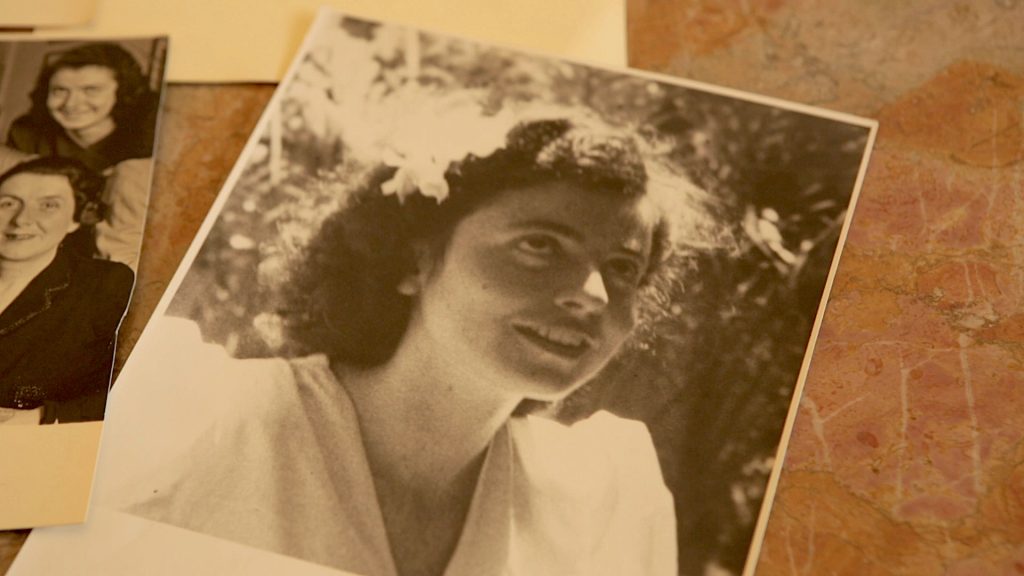
Elsa is a young woman, a bit small, she wrote this novel “La storia” weaving her personal story with her fictional character.
Ida is the daughter of a jewish woman, just like Elsa, bound to follow and to bend quite often to changing times, racial laws, the war and situations becoming more and more extreme and dangerous.
Ida has two sons, Nino, a bit reckless, and especially Useppe, whose story intertwines with those of people who enter and leave his life, a human life overwhelmed by war.
The newsreel exalts the fascist view of feminine figures and celebrates the Italo-Dutch friendship strengthened by Italy’s entry into the war.
Our journey in the imaginary of the “after war” begins with the representation of society during war. The main dream factory of the regime was the institute LUCE, The Educational Cinematographic Union, promoted in 1925 by Benito Mussolini.
The first newsreel was released in June 1927, which will
become one of the main nationalist and fascist propaganda instruments.
War always comes with an encounter. Not with Story, but with a person: a soldier, a uniform, a different language. Ida meets Gunther, a young German soldier. It’s not a battle scene, but forced closeness. War enters a room, everyday life.
“La Storia” by Elsa MoranteOne day in January 1941, a German soldier passing by, Gunther, was enjoying an afternoon of freedom, alone, wandering around the San Lorenzo district, in Rome.
It was around 2pm and, as usual, nobody was around. Anyways, none of the bystanders would look at him, because Germans, even though they were comrades with the Italians in the current war, were not as popular among working class suburbs. Nor the trooper was differentiating himself from the others of his race: tall, blond, with the usual rigid disciplinary adherence, and, especially with his hat position, evidently provoking. […]
He had happened, in truth, to grow unexpectedly all through the last summer and autumn; and meanwhile, in that frenzy of growing, his face, for lack of time, had remained just the same as before, so much so that it seemed to accuse him of not even having the minimum seniority required for his lowly rank. He was a simple recruit from the last war draft. And until the time he was called to his military duties, he had always lived with his brothers and his widowed mother in his native house in Bavaria, on the outskirts of Munich.
The woman, an elementary school teacher by trade, was named Ida Ramundo, widow Mancuso. In truth, according to her parents’ intention, her first name was supposed to be Aida. But, due to a clerk’s error, she had been registered at the vital statistics office as Ida, called Iduzza by her Calabrian father.
In age, she was thirty-seven full years old, and she truly did not try to look any younger. Her rather undernourished body, misshapen in structure, with a faded bust and a badly swollen lower half, was covered as best it could be by a cheap brown old woman’s coat, with a very worn little fur collar and a grayish lining showing its tattered edges outside the sleeves.
Interviews with women recounting experiences lived in another space and another time: the encounter with German soldiers, forced coexistence, fear, and at times the ambiguity of human gestures within an inhumane system. Different voices, one same condition.
War not as a distant event, but as an imposed relationship that forever scars those who endure it.
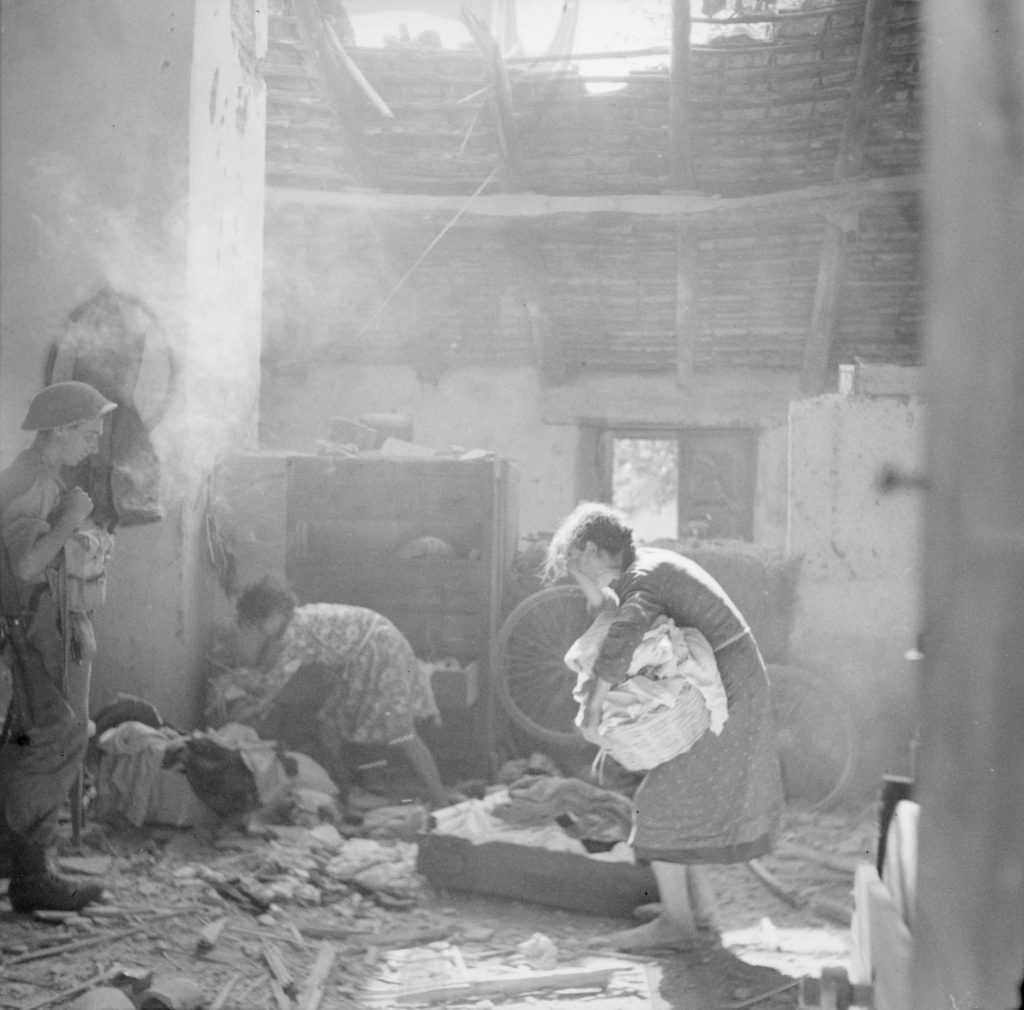
Fear, astonishment, or often a woman’s awareness of being unable to escape appears to men as yet another license for violence. Women are the primary victims of a war; they do not carry a rifle to defend themselves, but instead care for children and the elderly, alone and unprotected.
Ida is a woman just like any other, unaware that the door will open and that her destiny will change forever. Ida will suffer the same fate as so many others who came before her, and unfortunately, so many who are yet to come.
Ida was wearing a hat, secured with sewing pins, provided with a small black veil indicating she was a widow; beside that, her marital state was proven by a wedding ring (made of steel instead of the gold one, already offered to her country to sustain the war) on her left hand. Her frizzy black curly hair had started to gray, nevertheless aging left her round face and prominent lips untouched, by giving her the looks of a skinny child.
As a matter of fact, she had remained, deep down, a child, because her relationship with the world had always been (aware or not) a frightened uneasiness.
Therefore, it’s crystal clear as to why the unlucky woman, one day in January 1941, was perceiving her meeting with that soldier as a nightmare. Overwhelmed by fear, she couldn’t help but see a German military uniform. And in bumping into each other, right at her front door, in that uniform that seemed to be lurking while waiting for her, she thought she was attending a terrible appointment, predestined to her since the origin of the world.
The migrant foreigner in transit , now identifying himself with her heart, with no explanation, whiplashed in her. And atrociously fluttering around in the unnatural space of her room, it started to crash between a vociferous turmoil against dead end walls.
Ida’s body remained motionless, just like her consciousness. With no movement but a little muscle twitch and a helpless glance of extreme repulsion, as in front of a monster. In that exact moment, the eyes of the soldier, in their dark blue sea color close to purple (uncommon on the continent, usually seen on mediterranean islands) were full of an almost terrible innocence for their undated ancientness: contemporary to the Earthly Paradise!Her glance seemed, to those eyes, a definitive insult. Instantly a storm of anger darkened them. Nevertheless amongst this dimming was disappearing an infantile questioning, which was no longer expecting the sweetness of a reply; however it still longed for it.
It was at this moment that Ida started yelling for no apparent reason: «No! No! No!» with an hysterical voice of an immature girl.
“La Storia” by Elsa Morante
Women’s martyr
Cinema describes quite often violence on women allowed to troops, sometimes just as a “reward”, mostly as an humiliation device.
Violence is committed towards men and minors as well, but affects women in an incommensurate way. Violence is, in many cases, the result of an exacerbated gender inequality, already preexisting before war occurred, and that worsens during and after the war. (Camera dei Deputati, 2016 – “Indagine conoscitiva sulla tutela dei diritti delle minoranze per il mantenimento della Pace e della sicurezza a livello internazionale”)
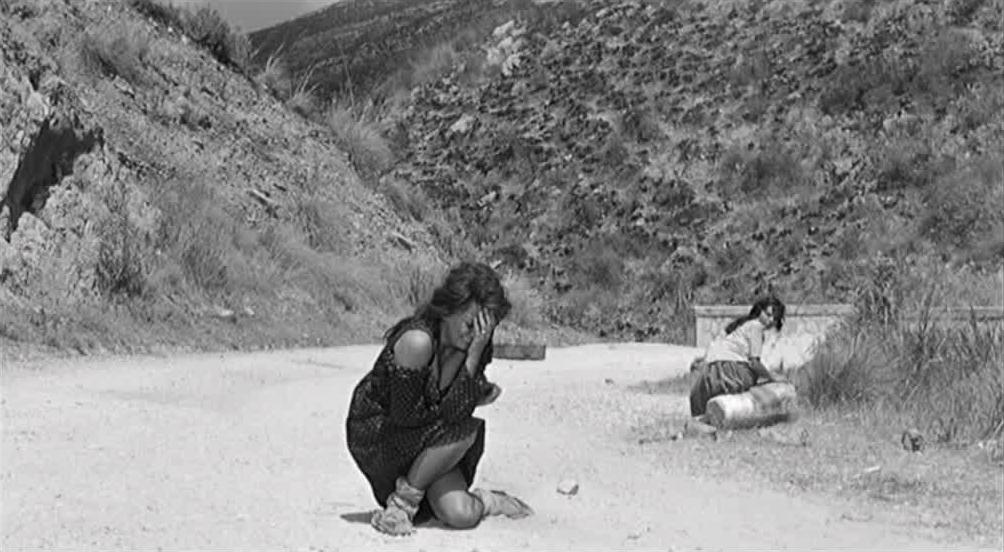
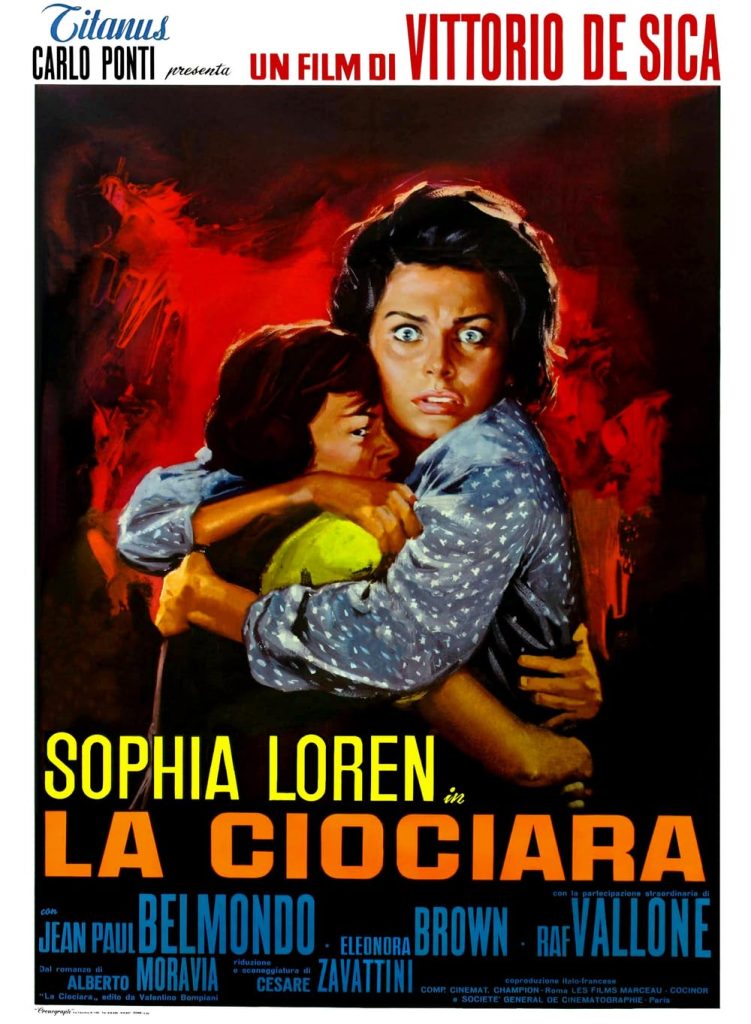
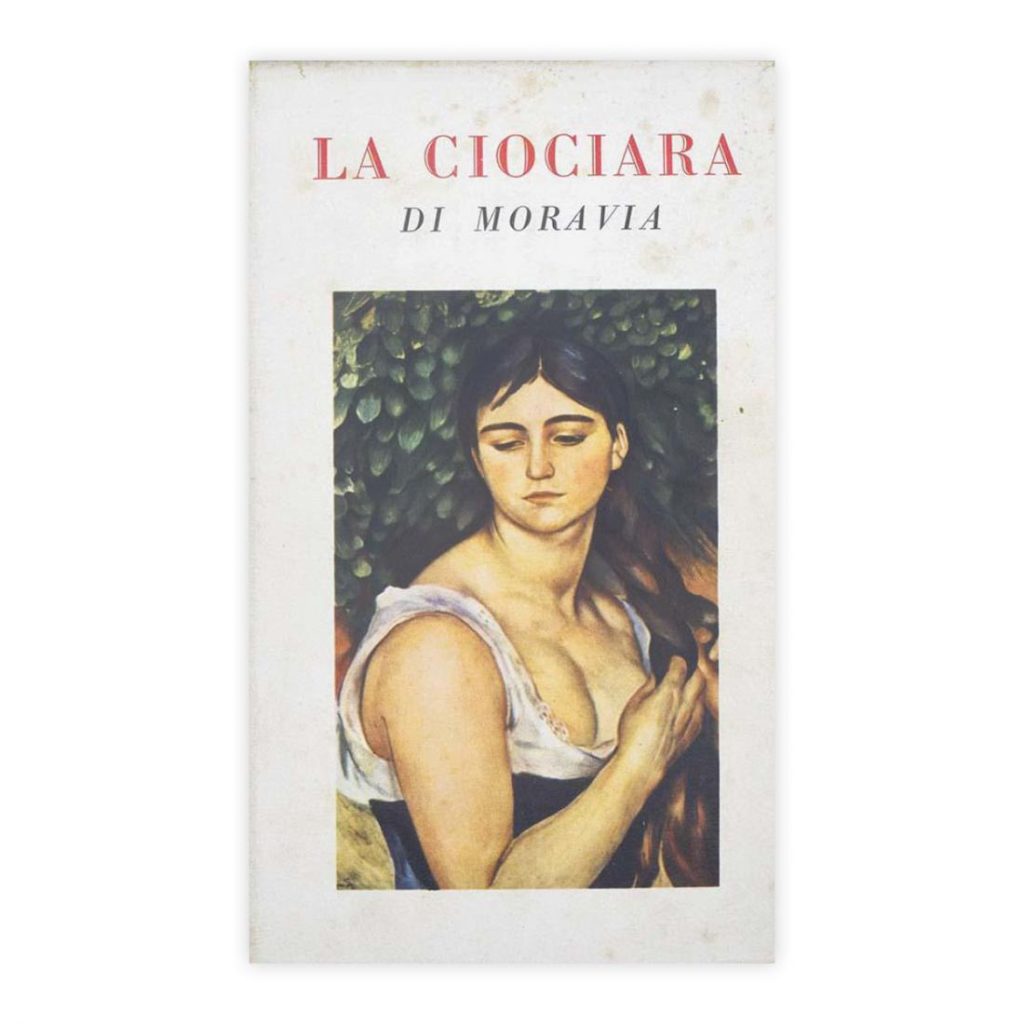
La ciociara, based on a novel by Elsa Morante’s husband, Alberto Moravia, and directed by Vittorio De Sica wins an extraordinary Sophia Loren the Oscar as best female interpreter.
It tells the tragic phenomenon of the “marocchinate” (the moroccans’ deeds), mass rapes committed by north african troopes, the goumiers, to their own allies, right in their journey to north after their landing in Salerno. But tendency toward violence doesn’t distinguish nationality: All military forces from every era are featured.
The inclination toward violence knows no distinction of nationality; all armies of all times are its protagonists.
Ugo Pirro, screenwriter, was nominated twice for the Oscar, particularly for Il Giardino dei Finzi Contini, drama of the wealthy jewish family from Ferrara, Finzi Contini, whose social and work life is disrupted by the introduction of racial laws.
Pirro was born in 1920, actually born as Mattone as surname, in what will later become (only in 1929 ) the city of Battipaglia, a preexistent farming community, elevated to a municipality by the regime, in line with the self-sufficient agricultural policy and creation of cities.
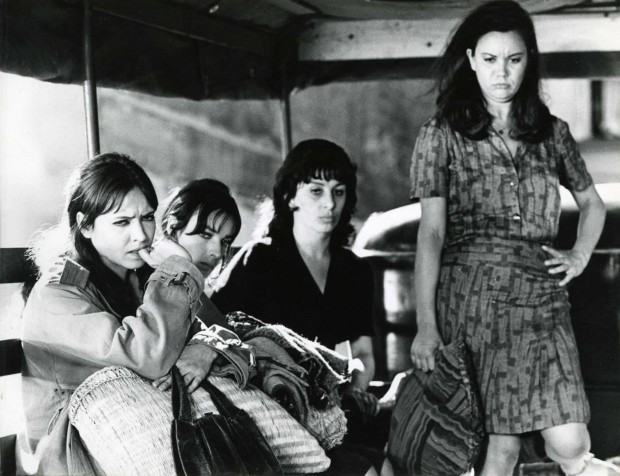
It will be Ugo Pirro to write the novel “Le soldatesse” from whom Valerio Zerlini will make a movie, in which violence on women is committed through the instrument of the poverty and starvation, young women forced to satisfy Italian soldiers in a Greece starved by Italian invasion.
The Italian-German occupation will cause death to hundreds of thousands Greeks “around 150.000 victims of the great hunger only in 1941” (Greekreporter – 2022).
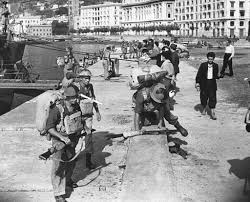
The ally’s arrival in Salerno, which followed the early announcement of the armistice with the allies, turned, in just a few hours, Italian soldiers in Greece from occupants to prays of the German army if not directly or indirectly victims.
Elsa writes «Every pain in the world feels the same, but a mothers pain lasts more.»
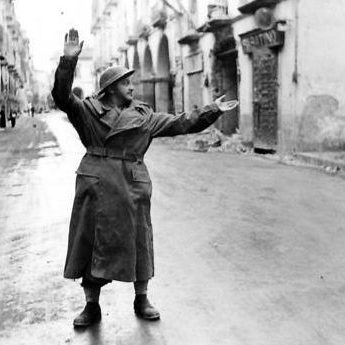
Salerno’s disembark had to, according to allies, loosen the German grip on the Russian front, where in January 1943 the ARMIR,Italian expedition, had started to fall back towards west. In September 1943 they were centered along the Dnepr river, right in those places where nowadays Russians and Ukrainians are fighting.
Belarus, where the movie is set, was reconquered by the Russians in 1944.
The Nazi’s blind violence, against Jews in particular, but also against Russian populations, is represented cinematographically in a raw and dramatic way in the movie “Come and see”, a journey through the eyes of a boy who happens to be the witness of the slaughter of an entire village in Belarus where Nazi held captive women, children and men not suited to work in a huge wooden barn on which the inscription “Hier”, “here” is engraved to indicate the gathering point. The barn, boarded-up, is set on fire and strafed.
An atrocious fate is experienced by those who are initially spared the martyr, but at the cost of extended violence that the producer doesn’t show, but they’re clearly evoked in war scenes.
In an allegorical scene the guy, blinded by rage starts to shoot ideally at Hitler in the various phases of his life until he stops in front of the image of him as a child in his mother’s arms, incapable of replying against the “Evil”, the violence he himself was subjected to.

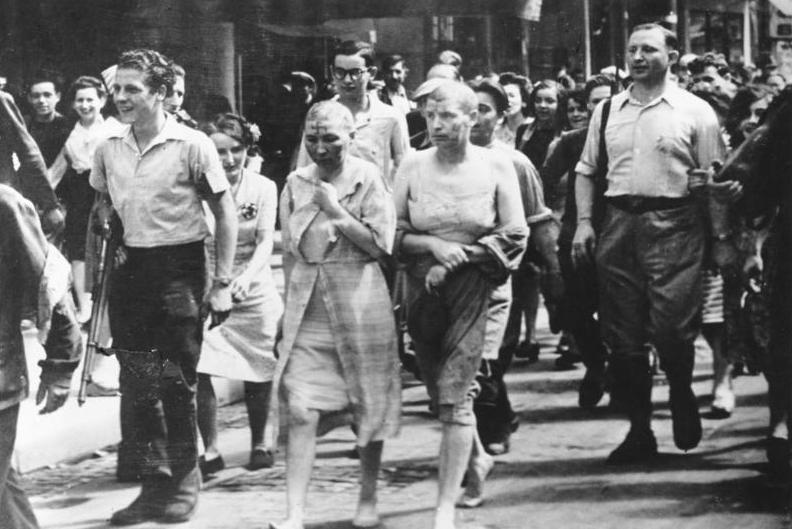
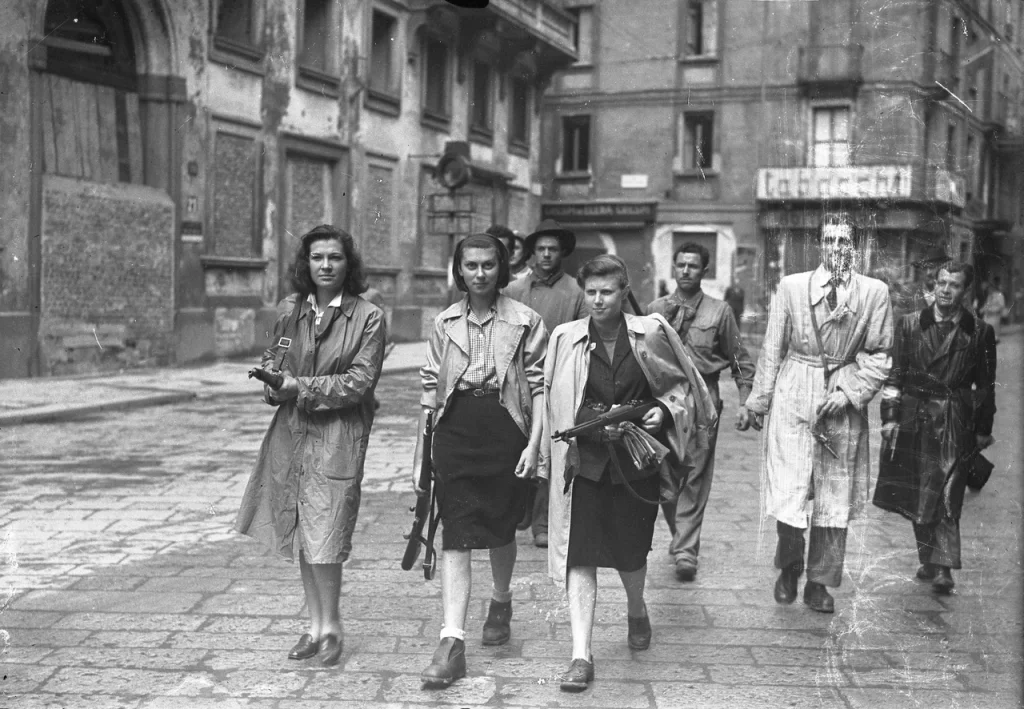
The end of the War doesn’t save from violence usage even those who had fought for freedom, the partisans and people who are avenging years of abuses and once again women are an easy target, against the “Evil” the violence experienced materialises itself through their humiliation.
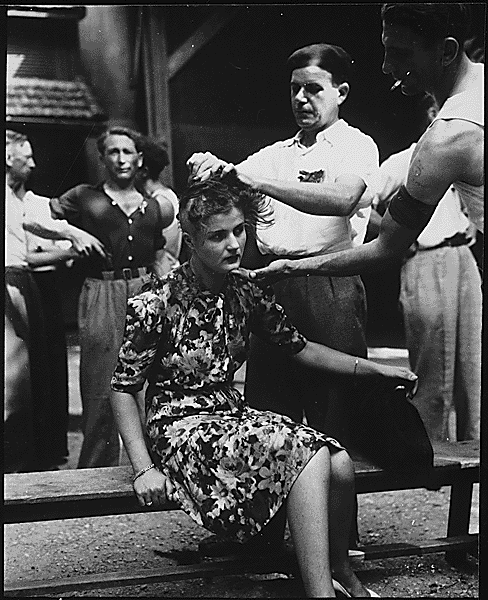
“La tondue de Chartres” (the shaved woman of Chartres) is the title of one of the most iconic è dramatic pictures of the France Liberation in 1944, taken by Robert Capa on the 16th of August 1944.
It referred to Simone Touseau, a 23-year-old woman from Chartres who was a victim of the épuration sauvage (savage purge). Like thousands of other French women accused of “horizontal collaboration “ (sentimental of sexual relationships with German soldiers), Simone’s head was shaved in public as a sign of infamy and humiliation. In Italy as well, there were cases of violence against women accused of collaborationism.
(Eure-et-Loir. Chartres, 18 agosto, 1944 (ph.Robert Capa, International Center of Photography / Magnum Photos / Agentur Focus))

The end of the war shows yet another face: the story of Ilse Koch, wife of Karl, commander of Buchenwald, who was also known as the “Witch of Buchenwald” (“Die Hexe von Buchenwald”) for her cruel sadism toward female (and male) prisoners.
27 February 2026
15 April 2026
15 April 2026
15 April 2026
28 March 2026