Women’s right to vote is closely linked to the role they historically played during the two World Wars. Their active role in society has been recognised not only as mothers and educators, but also as women capable of taking a stand, of overturning the established order if necessary, of carrying out the various tasks that had previously been attributed solely to men, and of managing situations connected with extremely serious and dangerous events such as war. Their courage, sensitivity, extraordinary ability and precision have highlighted their worth, and the importance of equality and reciprocity in the social, political and human spheres.
Some women come from socialist, Garibaldian, Sardist or Fascist family backgrounds. From a political point of view, most of the women interviewed began collaborating with political parties and the Resistance during adolescence or adulthood. Many women, particularly in southern Italy, supported the monarchy; others, instead, supported the republic and parties such as the Christian Democracy. Others still supported the Communist Party.

As far as political life is concerned, these women fought tenaciously and steadfastly for the rights of other women. One example is Amelia Ardias, who devoted the early part of her life to her family, whilst later played an important role in politics, receiving recognition even from America. She initially served as secretary to her husband, Guido Cortese (a lawyer and politician), collaborated with Il Mattino and, finally, became an active and integral member of the Liberal Party, as an advocate for women’s rights. This is her account:
testimony of Amelia Ardias (segment 5, “La vita politica”, in full).
The trade union (the case of Antonietta Zoradelli has already been mentioned, for example) became a voice for safeguarding women’s rights. Many women made use of this resource.
Giovanna Bitto is a hard worker; she cherishes the dream of studying and succeeds in graduating after many years. Within her company, INAM (National Institute for Health Insurance), she asserts workers’ rights; later, she begins collaborating with CISL and ACLI. She is also a member of the Equal Opportunities Commission of the Ministry of Labour.
Video: Giovanna Bitto (segment 10, “Il sindacato”, full interview).
Tina Costa collaborates with the Communist Party; she is highly active in political life. She knows many of the people involved in this historical period of transformation, for example Nilde Iotti, Adele Bei and Teresa Noce, who belong to the Constituent Mothers.
Testimony of Tina Costa (segment 8, “Il PCI e le sue esponenti donne”, in full).
Image caption from FONDAZIONE ISTITUTO PIEMONTESE ANTONIO GRAMSCI DI TORINO – POLO DEL ‘900
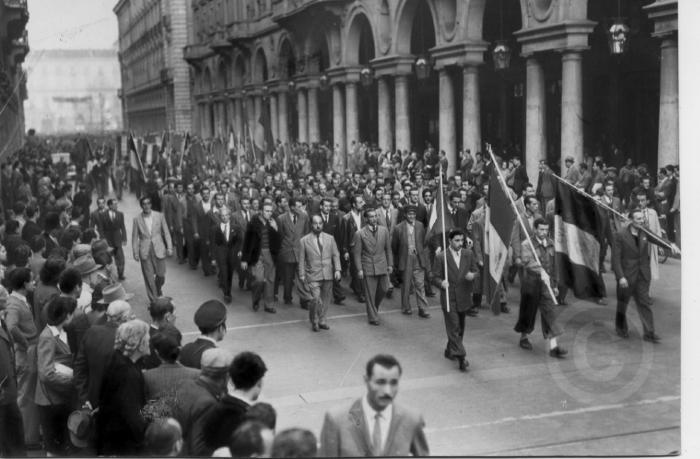
Women participated extensively in the Roman Resistance (the movement that began on 8 September 1943 and lasted until 4 June 1944, against the Nazi-Fascist occupation). During the conflict, the majority of women were partisans or staffette. They transported weapons, medicines and information. They helped with movements, even hiding men in their own homes (the loft being one example). They created a network of relationships and actively shaped history. Through such political activity, some women met the companions who would become their lifelong partners (truly sharing both good and bad fortune together). Women took risks, persevered and never gave up. They were vital cogs in the unfolding of history. Some women found themselves working alongside the Germans; others alongside the Fascists. Some women were discovered to be partisans, yet not all supporters of the dictatorships became informers. Such was the case of Luigina Forcella, who worked with a Fascist who understood her situation but said nothing, merely warning her. Out of gratitude, she would later defend him in court. Choosing a political movement is sometimes the result of the historical period in which one lives. Some people have chosen not to harm another person, even though their political movement dictates otherwise. War sets human beings, all brothers and sisters, against each other; inevitably, everyone loses. There are even women who have hidden both Fascists and Nazis, believing that some of them deserve it. One example is Antonietta Zoradelli; there is no justification for injustice in their reasoning.
Then came the Badoglio Proclamation (that is, the announcement of the Armistice between the government of the Kingdom of Italy and the Allies on 8 September 1943); this marked the entry into force of the Armistice of Cassibile, signed on 3 September. The Roman Resistance proved decisive against the Germans. The Patriotic Action Groups (GAP), made up of partisans, were established. In Rome, the GAP were led by Alfio Marchini, Antonello Trombadori and Roberto Forti. These central GAP units were divided into two networks that spread throughout the Roman territory. A woman, Carla Capponi, also collaborated with the GAP. She was a partisan who played an important historical role in the struggle against the Nazis in Rome. She took part in the attack on Via Rasella. This was followed by the German reprisal, the Ardeatine Caves massacre, liberation and reconstruction. Carla recounts her life in the book Con cuore di donna. Women therefore experienced active participation, but also hunger, poverty, destruction, fear and loss.
It is Iole Mancini, an active participant in the Roman Resistance, who speaks about Carla. Iole Mancini (segment 7, “La resistenza romana”, in full).
At night there were bombings, so women hid with their families. These events united people while at the same time destroying them; they bound them together and tore them apart. Simultaneously, they created a greater awareness of the uniqueness of one’s own life.
Silvia and Monalda Baldetti recount the war and the bombings in Chiusi, Tuscany; they tell of the hospital being bombed and the subsequent transfer of the sick and wounded to the large entrance hall of their home. Their father is a doctor. They speak of the Germans and the arrival of the Allies. The Germans knock on their door, asking for clothes so as not to be recognised by the British; they ask to stay. Later they leave, disappearing into thin air. Some Germans bomb the cemetery area, causing many deaths. The fighting creates a disastrous situation locally. When the war passes, the two women are able to return to their home; people once again fill the streets of the town, and there is a desire to rebuild and to live each day peacefully.
Adriana Amalfitani experienced the bombing of San Lorenzo, in which her sister was killed, she lost her home, and her mother was injured. She searched for her mother from hospital to hospital and eventually found her. She lived in various temporary accommodations until she found a permanent home. She recounts the details of that day:
Video: Adriana Amalfitani (segment 3, “Il bombardamento di San Lorenzo”, full interview).
Some women became prisoners (in the case of Rome, for example, in Via Tasso; imprisonment there was akin to torture. Women were forced to remain in a room with no space, where in almost every case there was an informer; consequently, it was impossible to speak freely).
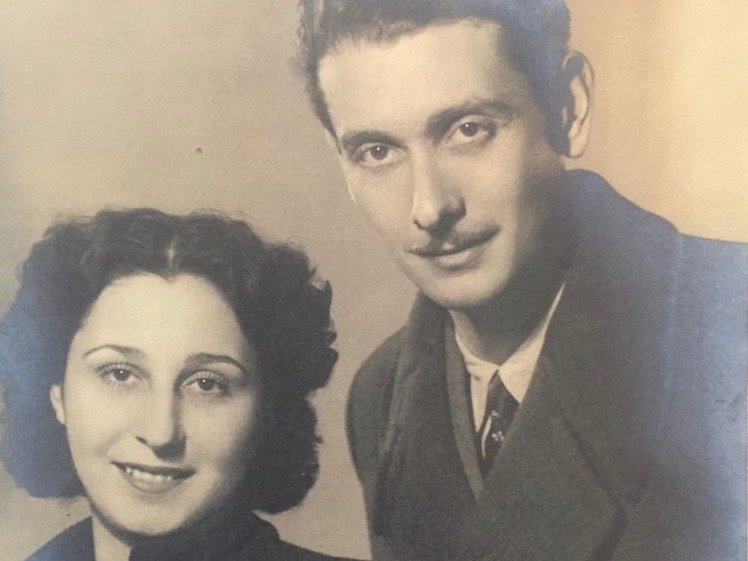
Iole Mancini explains: ‘Ernesto (my husband) was hidden in the loft by my father. Woe betide me if I’d mentioned my father’s name: the whole family would have been in trouble. So our creed was not to speak, to resist until death’.
She continues: ‘After almost four hours of this torture (the interrogation), with this spotlight shining in my face, they took me back to a small room, gave me a small wooden bowl, a wooden spoon, a blanket and escorted me to the third floor, where two women’s rooms were. There I was received; the room was a quarter of the size of this one. There were fourteen of us, almost sitting upright —you couldn’t lie down as there was no space on the floor. The window had wolf’s-mouth openings; on the outside it was a window with closed shutters, but on the inside it had been bricked up. So there we remained, poor souls, each with our own story. Only two women introduced themselves by their real names; all the others gave false names, because I’d heard that in prisons there was a spy in every cell, so you could never open up.’.
Finally, she recounts her release from prison with the arrival of the Americans: ‘Meanwhile I was in Via Tasso, living the life of all prisoners. It was well known that once you entered Via Tasso, you never came out. This went on for several days. Then, the evening of 3 June ’44 arrived. Throughout the week, we had smelt burning, and heard boots going up and down the stairs, because the American troops were approaching Rome and the Germans were making the archives disappear. That’s why, when we were liberated, almost all the archives of Via Tasso had gone—they’d been burnt. On the evening of the 3rd, the Germans opened my cell and took me downstairs with other men. We went down into the street, where there were lorries; one was already full, ready to leave, and it set off. They made us get into ours, but it did not leave because it had broken down. They made us get out again, took us back to our cells and locked us in. We were all shut in, but the Germans were no longer there. On the morning of the 4th, the Americans arrived and set us free. In the meantime, part of southern Rome had already been liberated, and relatives and neighbours from this street had gathered below; they opened the main gate and set us free. That was the greatest moment… It’s such a powerful feeling to know that you’re finally free, that you can talk to the person next to you without fearing that someone is spying behind you, that you can walk, that you can shout—you’re free. For us, on that day, the word ‘freedom’ took on a universal meaning. We were finally free, free to embrace our relatives and friends again. I was able to see my husband again on the 5th, because until then I hadn’t know whether he was alive or dead, or whether my relatives were still alive. Between the 4th and the 5th, our families were reunited, and finally the Fascist and German nightmare for Rome, for Italy, was almost over, although northern Italy still had to be liberated; that took many more months. But, at last, the Allies and the partisans—and we must never forget the contribution made by the partisans, including women, to the liberation of Italy, at the cost of so many deaths, so many. Yet the struggle was over, at last… there were… dreams could almost come true.’
Another testimony of imprisonment comes from Vera Michelin Salomon, this time ending in a concentration camp in Germany (she was initially held in Via Tasso prison, then in Regina Coeli; afterwards she was sent to Germany. She spent one month in Stadelheim, in Munich, before being transferred to Aichach). Vera met friends who opened the doors of culture to her; she stayed in their flat for a while, began to develop a passion for politics and freedom to think and to act, and read many books. Throughout her life, she lived with her family in various cities across northern and southern Italy. She became a free spirit, expressing her inner freedom despite imprisonment and years of hardship, remaining strong and determined. She recounts the years of imprisonment and liberation, shared with women of every nationality, yet all united by a common fate in that historical period, each with her own individual story.
Pillole Partigiane: Vera Michelin Salomon (from minute 00:00 to minute 2:55).
‘That was liberation. And there too the lilacs were in bloom’. These words of hers fully express the new condition, both outwardly and inwardly. The lilacs have blossomed.
Right up until Liberation, they remained united and resolute, and together, through resilience in the midst of the tragedy of war, they created their own future, a new future. Women from different nations (the war had bound together the fates of different peoples and cultures) reached the end of the conflict together. They were reborn. Through their tenacity, they conceived a new status for women and a new world. Women, finally, began to experience freedom.