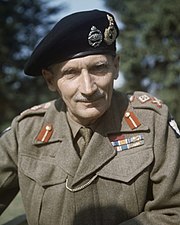
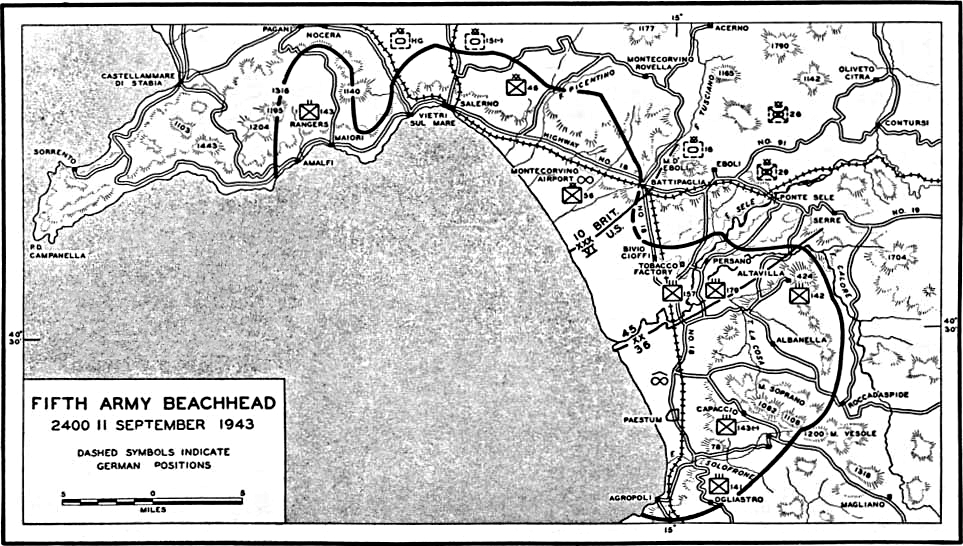
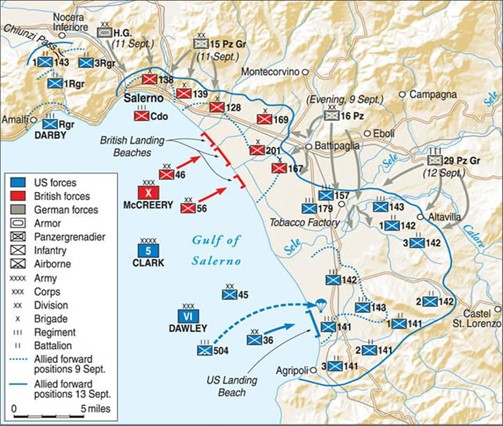
Alle 3:30 del mattino, 5° Battaglione del Hampshire Regiment, appartenente alla 128a Brigata della 46a Divisione di fanteria britannica, al comando del Generale John L.I. Hawkesworthi salì sui mezzi da sbarco, mentre le artiglierie navali alleate bombardavano la costa. Tuttavia, le postazioni tedesche non erano state del tutto neutralizzate. Durante l’avvicinamento, i soldati furono bersagliati da colpi di artiglieria tedesca che causarono caos e terrore. Alle 4:30 sbarcarono in un vero e proprio inferno di fuoco, con il 1°/4° Battaglione Hampshire ancora impegnato in aspri combattimenti sulla spiaggia.
Alle 6:00, accortisi di essere sbarcati più a sud del previsto, gli ufficiali diedero ordine di muoversi verso nord in località Magazzeno per raggiungere la zona designata.
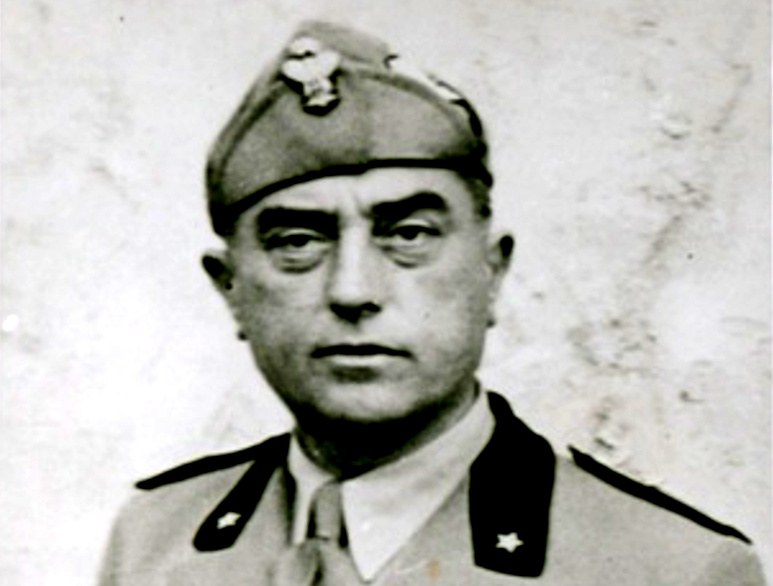
Una colonna corazzata della 16a Divisione Panzer, agli ordini del tenente Gustav Meierkord, avanzava nel frattempo lungo una delle strade che dalla Statale 18 portavano verso il mare. Era composta da una compagnia di granatieri e tre carri armati. Lungo un tratto di strada delimitato da alte mura, i tedeschi intercettarono la marcia del 5° Battaglione.
Il primo carro tedesco, avvistati i soldati britannici, aprì il fuoco con cannone e mitragliatrici. Gli inglesi, sorpresi e privi di armi anticarro, tentarono di fuggire attraverso i campi. Molti non ci riuscirono. I granatieri tedeschi li circondarono e centinaia furono costretti ad arrendersi.
Il carro armato proseguì l’avanzata fin quasi alla costa, travolgendo i corpi di feriti e caduti. Solo l’arrivo di artiglieria alleata ne costrinse la ritirata.
Il bilancio fu drammatico: 40 militari britannici caddero, tra loroil soldato Reginald Henry Stocker, e oltre 300 furono fatti prigionieri.
Il giovane Reginald Henry Stocker, nato nel 1922 a Shirley, Southampton, era partito dal porto di Biserta tra il 6 e il 7 settembre, senza conoscere la destinazione finale. Solo l’8 settembre scoprì che l’obiettivo era il litorale salernitano, dove sarebbe iniziata una delle fasi più dure della Campagna d’Italia. I resti di Stocker e dei suoi commilitoni riposano oggi nel cimitero di guerra britannico di Montecorvino, nel settore III Corpo, Fila C, Posto 29.
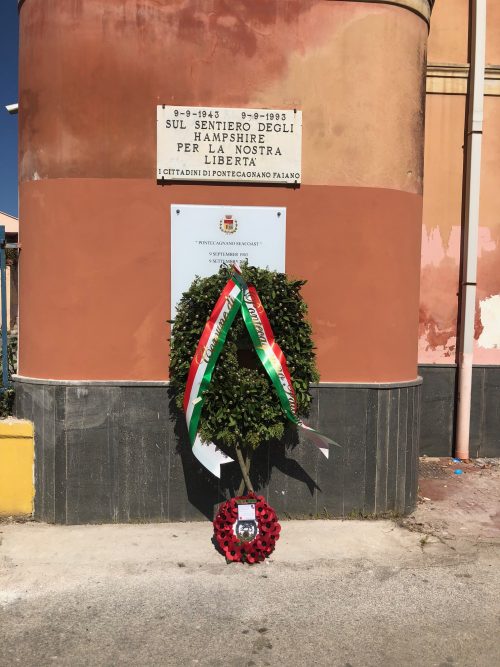
Il luogo dello scontro è oggi conosciuto con il nome di “Hampshire Lane”, il Sentiero degli Hampshire, a ricordo del sacrificio di quei giovani soldati sbarcati su una spiaggia che doveva essere sicura, ma che si rivelò un campo di morte
At 3:30 a.m., the 5th Battalion of the Hampshire Regiment, part of the 128th Brigade of the British 46th Infantry Division under the command of General John L.I. Hawkesworth, boarded the landing craft while Allied naval artillery pounded the coastline. However, the German positions had not been fully neutralized. As they approached the shore, the soldiers came under heavy German artillery fire, which caused chaos and terror. By 4:30 a.m., they had landed in what can only be described as a hellish inferno, with the 1st/4th Hampshire Battalion still engaged in fierce combat against German troops entrenched just beyond the beach.
At 6:00 a.m., realizing they had landed further south than planned, the officers ordered the battalion to move north toward the Magazzeno area to reach the designated position.
Meanwhile, an armored column from the 16th Panzer Division, under the command of Lieutenant Gustav Meierkord, was advancing along one of the roads leading from Highway 18 toward the coast. The group consisted of a company of grenadiers and three tanks. As they moved along a stretch of road flanked by high walls, the Germans intercepted the advance of the 5th Battalion.
The lead tank, upon spotting the British troops, opened fire with its cannon and machine guns. The British infantry, caught off guard and without anti-tank weapons, attempted to flee into the surrounding fields. Many failed to escape. The German grenadiers encircled them, and hundreds were forced to surrender.
The tank continued its advance almost to the shoreline, crushing the bodies of the dead and wounded under its treads. It was only the arrival of freshly landed Allied artillery units that forced it to retreat.
The outcome was devastating: 40 British soldiers were killed, including Private Reginald Henry Stocker, and more than 300 were taken prisoner.
Reginald Henry Stocker, born in 1922 in Shirley, Southampton, had departed from the port of Bizerte between September 6th and 7th, unaware of his final destination. It was only on September 8th that he learned they would land on the coast of Salerno, the site of what would become one of the most intense phases of the Italian Campaign.
The remains of Stocker and his fallen comrades now rest in the Montecorvino British War Cemetery, in Plot III, Row C, Grave 29.
The location of the clash is now known as “Hampshire Lane”, a name that preserves the memory of the young soldiers who landed on a beach meant to be safe, but which became instead a killing ground.
Un débarquement sous le feu
À 3h30 du matin, le 5e bataillon du Hampshire Regiment — appartenant à la 128e brigade de la 46e division d’infanterie britannique, sous les ordres du général John L.I. Hawkesworth —est monté à bord des barges de débarquement, tandis que l’artillerie navale alliée bombardait la côte. Cependant, les positions allemandes n’avaient pas été totalement neutralisées. Durant l’approche, les soldats ont été pris pour cibles par l’artillerie allemande, ce qui a provoqué chaos et terreur. À 4h30 du matin, ils ont débarqué dans un véritable enfer de feu, alors que le 1er/4e bataillon Hampshire était encore engagé dans de violents combats sur la plage.
À 6h00 du matin, s’apercevant qu’ils avaient débarqué plus au sud que prévu, les officiers ont donné l’ordre de se diriger vers le nord, dans la localité di Magazzeno, afin de rejoindre la zone désignée.
La contre-offensive allemande
Pendant ce temps, une colonne blindée de la 16e Panzer-Division, sous les ordres du lieutenant Gustav Meierkord, avançait le long d’une des rues menant de la route nationale 18 vers la mer. Elle se composait d’une compagnie de grenadiers et de trois chars. Sur un tronçon de route bordé de hauts murs, les Allemands ont intercepté la progression du 5e bataillon.
Le premier char allemand, ayant repéré les soldats britanniques, a ouvert le feu au canon et à la mitrailleuse. Les Britanniques, surpris et dépourvus d’armes antichars, ont tenté de s’enfuir à travers les champs. Beaucoup n’y sont pas parvenus. Les grenadiers allemands les ont encerclés et des centaines d’hommes ont été contraints de se rendre.
Le char a poursuivi son avance jusque près de la côte, écrasant les corps des blessés et des tombés. Seule l’arrivée de l’artillerie alliée l’a contraint à se retirer.
Le bilan a été dramatique : 40 militaires britanniques ont perdu la vie, parmi lesquels le soldat Reginald Henry Stocker, et plus de 300 ont été faits prisonniers.
La tragédie et la mémoire
Le jeune Reginald Henry Stocker, né en 1922 à Shirley, Southampton, était parti du port de Bizerte entre le 6 et le 7 septembre, sans connaître sa destination finale. Ce n’est que le 8 septembre qu’il a découvert que l’objectif était le littoral de Salerne, où allait débuter l’une des phases les plus dures de la campagne d’Italie. Les restes de Stocker et de ses compagnons d’armes reposent aujourd’hui au cimetière de guerre britannique de Montecorvino, dans le secteur III Corps, Rangée C, Tombe 29.
Le lieu de l’affrontement est aujourd’hui connu sous le nom de « Hampshire Lane », le Sentier des Hampshire, en souvenir du sacrifice de ces jeunes soldats débarqués sur une plage qui devait être sûre, mais qui s’est révélée être un champ de mort.
Traduction par Asja Vergati